Sunday, December 21, 2014


Hope, Dreams, and Pride

(Walter’s point of view)

                As my father says, “Seem like God didn’t see fit to give the black man nothing but dreams – but He did give us children to make them dreams seem worth while” (Hansberry 46).  A man can swallow his pride – but he don’t got no right to swallow someone else’s.  Today, I was ’bout ready to swallow mine, though it was gonna darn near kill me, ’cause we needed that money, man, we needed it bad.  But Travis … he’s my boy.  And I just couldn’t take from him that feeling that we are equal people, and have got the right to walk the earth just as much as any white man does.  Me and my family – we’re simple people.  And my wife, Ruth, is gonna bring us another baby.  Who am I to tell that baby he or she don’t count as much as the white folks do?  Who am I, man, Who – am – I?  I got me some dreams.  I’m gonna make a great life for my family yet.  My last dream done “Dr[ied] up like a raisin in the sun,” (Hughes) but I’ve learned my lesson.  A man don’t need no millions of dollars to be happy.  I’ve got a dream where all men, woman, and children, black and white, can respect each other as equals.  I’ve got a dream of a world where no man has to be any other man’s servant, just his own.  I’ve got a dream where a man can earn his place, “brick by brick” (Hansberry 148).  I’ve got a dream that my sister is going to be a doctor, that our Mother is going to retire in peace, that my wife will be a lovely mother of two beautiful children.  A man can get down on his luck, down on himself.  He can think about giving up his dreams.  But, for the sake of his family, not just those who are family by blood but family by brotherhood, he’s got to pick himself up and keep dreaming.  I’ve got myself a dream – and it’s going to “explode” (Hughes).

 
"Montage of a Dream Deferred"
 
What happens to a dream deferred?
 
Does it dry up / Like a raisin in the sun?

Or fester like a sore - /And then run?
 
Does it stink like rotten meat?
 
Or crust and sugar over - /Like a syrupy sweet? 

Maybe it just sags / Like a heavy load. 

Or does it explode? 

- Langston Hughes

Sunday, December 14, 2014

Puzzle Paragraph 1 I did it in three sentences - can I get bonus points? :)

Today, everyone hears about celebrities with more money than they could ever need going crazy; no one would be overly surprised if a billionaire decided to search the Savannah for pink elephants or imagined he or she was the modern-day Moses.  When Fitzgerald writes of the ridiculously rich in his story “The Diamond as Big as the Ritz,” it isn’t just another story meant to teach a lesson with talking animals and the classic “Once upon a time…” beginning traditionally vital for a story to teach morals.  Fitzgerald uses a different approach: extreme exaggeration of what occurs in our time, his famous rhetoric making the impossible seem possible and the reality of greed and materialism terrifying enough to make anyone feel "a little tired of diamonds"  (Fitzgerald XI).

Saturday, November 29, 2014


Prompt from V-blog: Is it true that we spend too much of our lives convincing others that we are someone we are not?

Be yourself – eat the potatoes!

To be blunt, yes – we each expend disproportionate amounts of effort and time on attempting to convince others that we are something or someone we are not.  The most obvious example I can think of from The Great Gatsby is the fact that four people are kept from living their lives with the one each truly loves, because three of them are pretending to love someone else – namely, each maintains the façade of loving his or her present spouse.  Myrtle is married to George Wilson, but Myrtle loves Tom (who reciprocates her affections), though Tom is married to Daisy, who is in love with Gatsby, who loves her as well.  As Catherine confides to Nick, speaking of Tom and Myrtle, “Neither of them can stand the person they’re married to.” (Fitzgerald 37).  She follows this with a suggestion heaping with beautiful common sense like delectable potatoes on a Thanksgiving platter, asking “Why go on living with them if they can’t stand them?  If I was them I’d get a divorce and get married to each other right away.” (Fitzgerald 37).  This really would seem to make the most sense – if two divorces were attained in short order, four people would be much happier: Myrtle, Tom, Daisy, and Gatsby would each be free to marry the person he or she loves (sucks to be George).  Sadly, at least as far into the book as I have read, each involved sustains the pretense of being someone he or she is not.  The lesson would seem to be stated more plainly, in actuality, in Hawthorne’s The Scarlet Letter: “Above all else, to thine own self be true.” (I don't recall the page number).

I’ll be true to myself by going to devour some of the aforementioned potatoes now, since I truly love good food J

Sunday, November 23, 2014


“What’s in a name?” – Juliet, balcony scene

                In the first two chapters of The Great Gatsby, Fitzgerald caused me initial confusion by using multiple names for the same character.  In class, though, Ms. Valentino explained that Fitz changes how he refers to his characters depending on whom else the characters are with.  For example, the woman whom Tom loves is referred to by her first name, “Myrtle,” (Fitz 40) when she discusses how she met Tom, to represent how in that situation she felt a free person and an individual.  However, when Tom is arguing with her about her right to say the name "Daisy" (Fitz 41), she becomes “Mrs. Wilson” (Fitz 41), to show the separation between Tom and herself created by others who have influence over their lives (Tom is married to Daisy, and Myrtle to George Wilson).  Others around us constantly influence who we are, and Fitz chooses multiple names for a person to show this.


                In Romeo and Juliet, Juliet contemplates the significance of name.  Specifically, she notes that Romeo’s last name, Montague, can only keep him her enemy if he and she allow the feud between their families to control the individual choices Juliet and Romeo make.  She remarks “’Tis but thy name that is my enemy.” (Juliet, balcony scene)  Our names control us in that they may affect how others perceive us.  However, we ultimately choose for ourselves who we want to be.  Romeo and Juliet perceive each other not as a Montague and a Capulet, mortal enemies, but as Romeo and Juliet, who love one another. 

Sunday, November 16, 2014


I WROTE A POST UNDER 200 WORDS!!!!! (It matches my point).
Claim:  There should not be a static set of punctuation rules enforced, as flexible punctuation maintains freedom of expression, enables efficient communication, and allows for adaptation of the written word as society morphs continuously.
Paragraph: Enables efficient communication
            Punctuation’s purpose is to aid communication.  Out-dated, misunderstood, and occasionally contradictory rules for punctuation can get in the way of those trying to communicate their meanings with speed and accuracy in the modern world.  Far from “contributing to the downfall of literacy in the modern world” (Associated Press), changing ways of expressing ideas with the written word are helping to create a new type of literacy that prioritizes, valuing speed more than formality.  When the barriers of the old rules are broken down, “a trail of possibilities” (Austen) opens up.  As Ben Dolnick, a writer for The New York Times, states, “simplicity, in all things, is a virtue” (Dolnick).  Why should one bother to use – or omit – punctuation in a manner that follows a rule, but isn’t the most easily written or understood?  In times where speed is often of vital importance, “less is more.” (Cosco)


Sunday, November 9, 2014


Understanding is the way

(Um, I kind of wrote an essay … don’t read this post if you’re looking for something short and sweet.)         

Confusion is one of the most terrifying difficulties to face.  With enough clarity, a solution can be found to any problem; without understanding, hope is scarce.  Throughout The Bluest Eye, Morrison encourages the realization that comprehension is already present, and that a solution can therefore be found if initiative is taken.

When Soaphead Church writes a letter to God, Morrison shows a surprising depth of understanding in the man of an otherwise twisted mind.  Reflecting on his past attempts to be something he was not, Church writes, “We were not royal but snobbish, not aristocratic but class-conscious” (Morrison 177).  Morrison juxtaposes these similar words of differing connotation to demonstrate the clarity Church has found.   He realizes as he reminisces on the errors he committed in his attempts to be white as he perceived white to be, and avoid being black as he perceived black to be, the truth: he needed to accept his black heritage to truly be the best he could be.  If only he had realized it sooner, things could be different, as he writes, “Now.” (Morrison 177)

Cholly knows subconsciously what does not occur consciously to him – the reason he hates his own people, the black, instead of the white.  Morrison describes with a simile how his hatred “would have burned him up like a piece of soft coal” (Morrison 151) if directed toward the white men who were truly to blame for his shame.  Cholly feels internally the truth: he does not risk the peril of hating those who have power over him because hating those who do not command such power is easier.  His misdirected animosity towards the members of his own race is destructive both to himself and to others.  If only he had listened to what he heard from within.

When Pecola is tricked into poisoning a dog, the dog looks at her with “soft triangle eyes.” (Morrison 176).  Morrison chooses these two adjectives to indicate two related aspects of the dog’s gaze that are central to Morrison’s message: soft represents forgiveness, and triangle is an ancient symbol for change.  As poison destroys his body, the dog communicates this hopeful message to Pecola: forgiveness for actions past can lead to change for the future. 

For all of Morrison’s characters, it is too late to save themselves.  However, there is an extant chance that those for whom there is still time can save themselves and all those around them.  Understanding is present in all, but action present in few.  If only people can find it within themselves to accept their instinctual understanding and put the past behind them, change will be at hand, so that all might proclaim, “Thank God Almighty, we’re free at last.”

[Does anyone remember whom that quote is from?:)]

Sunday, November 2, 2014


Grammar’s relevance in today’s society

We took are lovely Grammar Test on Thursday – how exciting!  We now (hopefully) have an excellent grasp of English grammar.  Yes, that knowledge may have got us (again, hopefully) good grades on our test, but how much does that matter?  Do we even need the goodest grammar anymore?

In that paragraph above I make three grammatical errors – one ridiculously obvious, one semi-apparent, and one that I'll be impressed if you catch.  Can you find all three?  The kicker is this: regardless of whether you do or do not see all three errors, my meaning is still clear.  Why, then, does grammar matter?

Sometimes, a grammatical error does change the meaning.  For example: then vs than.  I was taught the importance of that difference when I was shown this humorously errant post on twitter: I’d rather be pissed of then pissed on.  Then refers to time; than refers to comparison.  This person should have used than then, rather than then.  Get it?

In addition, a lack of grammar savvy can totally destroy your credibility, as when a person campaigning to make English the mandatory language in the U.S. became infamous for holding up a protest sign that said: “Respect are country!  Speak English!”

Does proper grammar matter, as long as a meaning is communicated?  What’s your opinion?  Weird Al shares his: https://www.youtube.com/watch?v=8Gv0H-vPoDc  Actually, I have his voice in my head every time I think of certain grammar rules, and I don’t think I’ll ever forget them. J

Sunday, October 26, 2014


The Power of the Pun

                There seem to be two types of people in the world: those who appreciate the art of the pun, and those who do not.  I am of the former group, and as such often attempt to use puns.  Unfortunately, these attempts are met with the very polite “shut up” or with less polite, but more creative, descriptions of how I shall come to bodily harm if I do not stop making puns.

                Despite the disdain for puns many people I know express, many of the stories we read in English Class are created by skillful authors who use puns very strategically.  At the start of the Shakespearean play Julius Caesar, which we read last year in 10 Honors English, a common man, a cobbler, uses a lengthy string of puns in an argument against a high-and-mighty Senator.  The Senator has a plethora of Ethos, which might make those witnessing the argument support him; thus, the “mender of bad soles” (J.C., Act I, Scene I) decides to undermine such respect and gain support for himself by showing off his wit with a series of clever puns that get his point across without seeming blatantly disrespectful to the Senator.  In Hawthorne’s The Scarlet Letter, mistress Hibbins refers to Dimmesdale as “The Prince of Air.” (Hawthorne p#)  Hawthorne chooses that exact wording to subtly remind readers of how Dimmesdale, despite his revered reputation, errs by committing adultery, and subsequently by hiding his sin.

                The question is, why do puns work?  Much of what we study in class is about meaning beneath the surface, but such meaning is discovered after in-depth discussion and deep thinking.  Authors, however, know that many members of the intended audience of a piece of literature will never do anything more than casually test the waters before moving on.  To communicate deep meaning, authors are thus forced to pander not to the audience’s conscious reasoning - which can yield a treasure of understanding only with focused effort on the audience’s part - but instead to the audience’s subconscious, which picks up hidden clues even without an audience member’s intent to do so.  When someone reads or hears a pun, that person might never actually say “Oh! The author is reminding me of ____!”  However, the subtlety of puns can work wonders on the psychological level, manipulating an audience member into forming the conclusions desired by the author.  Puns anchor the audience member naturally to the general area the author wants the audience member to end his or her voyage at, with a bit of leeway still remaining for the formation of unique hypotheses.

I have a sinking feeling that most people didn’t sea the common theme of my paragraph above, but I’m not shore.  However, I’m hoping you picked up on it subconsciously. J

Sunday, October 19, 2014


Slightly Slipshod Synthesis, Somewhat Shortly Sorting Sources’ Symbolic Suggestions

Everyone has something unique to offer us.  What a person is on the surface should not prevent us from appreciating them for who and how they are.  Many of the pieces we have read, including The Scarlet Letter, The Lone Ranger and Tonto Fistfight in Heaven, and Black Men and Public Spaces, suggest that every person should be accepted – by both himself or herself and by others – because each person has individual abilities and natural gifts to offer, and discrimination based upon what a person is can jeopardize the well-being of both the one oppressed and any who oppress.

To provide QUICK examples (because I really need to work on using brevity):

·         In The Scarlet Letter, Hawthorne repeatedly remarks on all the good Hester does to help others.  She has so little in terms of material wealth, and yet she gives any excess to the poor, who often refuse her charity or accept it with bad grace because Hester has been labeled a sinner.  However, once the townspeople learn to look past what Hester is – an adulterer, as her scarlet A originally stands for - and begin to look at Hester for who and how she is, they rebrand the Scarlet Letter and its wearer, saying that the A stands for Able.  The townspeople are then able to gladly accept the efforts that they had previously denied themselves the benefits of.

·         In The Lone Ranger and Tonto Fistfight in Heaven, “Victor” tells of how he is hated by others for his Native American heritage.  He is a brilliant kid, far ahead of the rest of his classmates, but instead of valuing Victor’s intelligence and appreciating his heritage, his teacher attempts to punish him for it, and orders that he shorten his hair to be like normal white people.  Despite this, Victor remains proud of his heritage, and by the time he graduates, he describes his hair as “longer than ever” (Alexie), representing how he decides to accept what he is as part of how and who he is: someone who rises up and does his best despite adversity.

·         In Black Men and Public Spaces, Brent Staples reveals the ambiguity of the labels “oppressor” and “oppressed” when he explains how the “victims” of crimes aren’t only those directly harmed by them, but those who are discriminated against as a result of such crimes’ habitual perpetration by people of certain groups.  Staples is the kind of person who would try to help someone in danger, but says that he only has to walk into a dangerous situation to risk getting killed in the name of “self-defense”.  People see what he is – a black male – and it often prevents them from seeing who he is: a kind, gentle person who would much sooner help than harm.

Darn it – so much for brevity.

I think I’ll stop writing now, before I overdo this any further.

Have a splendid day, and remember to appreciate people for how they choose to be.  We cannot change what we are – that is out of our control.  However, we all make decisions daily about how we want to be, and who we aspire to be.  I am a person who tends to write way too much.  But now, I choose to be a person that knows when to stop speaking. (shut up now, me!)  Who do you choose to be?

Saturday, October 11, 2014


Seeing differently

We all see things differently – textures, shadows, shapes, color, movement, depth, light.  However, the discrepancies in the ways we literally see are infinitesimal compared to the plethoric deviations of opinion among any number of people: divergences of metaphoric sight.  No two people are able to perceive a situation identically; each person has a brain that functions uniquely, and so each person will inevitably think in a distinct way.

                In Nathaniel Hawthorne’s story of The Scarlet Letter, the narrators remark on how “there was more than one account” (Hawthorne 252) of what transpired on the day Dimmesdale passed away.  Most of the witnesses apparently agreed that Dimmesdale had a scarlet letter on his breast to match Hester’s famous A.  However, they disagree over the origin for Dimmesdale’s mark, proposing such theories as

·         The minister put it there himself as a torturous form of penance

·         Roger Chillingworth, being a necromancer, used magic and drugs to cause the mark

·         The symbol appeared as the effect of Dimmesdale’s horrible guilt, the spiritual essence of Dimmesdale affecting his physical being so profoundly

The narrators declare that the readers “may choose among these theories.” (Hawthorne 253)  The narrators also want the readers to note that some people denied that there was ever a mark at all on Dimmesdale’s breast.  Why?  The narrators suggest that this variation of the story stems from  “that stubborn fidelity” (Hawthorne 254) that causes a person’s closest  friends to support him or her despite obvious proof against that person, especially when that person is a clergyman.  As Ben (I think) suggested in class, Dimmesdale’s fellow clergymen might have been trying desperately to preserve the honor and eminence that their profession usually afforded them, which would have been called into question when the seemingly most holy and clearly the most venerated among them was revealed to be a hypocritical sinner.  I think this might have been for selfish reasons, or it might have been for the greater good; Dimmesdale himself says that he hates being unable to confess his sins, but that he knows he can do far more good for the people of the settlement if they still believe in his purity.  I also believe that some of the clergy may truly not have seen a sign of sin on Dimmesdale, because they had so much faith, it altered their vision of reality.

                Ultimately, my point is this: the way we perceive a situation, idea, person, or other object can affect how what we perceive actually is.  This has to do with my very first post and theological stuff that hurts the brain, but we can change the world around us by thinking differently.  Many people disbelieve me when I talk about the effects of thinking positively - I get a lot of, “Oh, for God’s sake, Michael, shut up!”  However, many others understand the tangible effect that a different perspective can have in our lives.  Some tie it to science, (take two minutes to read this article, it’s cool)


while others connect the concept of positive thought altering our lives to their religions.  Personally, I use both as evidence.  As far as science goes, there have been innumerable studies that validate the idea that thoughts can affect reality, though science is still working on explaining why this is the case.  As far as religion goes, I’ve witnessed enough miracles in my life to feel the power of faith and belief in God.  Whatever you believe, try living with a more positive outlook, just for one day or one week, and see how it affects you.  You don’t need to read any more of my writing; the proof is in the pudding.*

*That’s a cliché meaning that the results will speak for themselves, in case you were confused and just though I wanted food.

Sunday, October 5, 2014


This week we read a short piece by Deborah Tannen called “There Is No Unmarked Woman”.  Tannen discusses how men and women are judged differently based on their appearance, making her case that while men find it easy to go under the radar, thus going unmarked, women have no such option.  Tannen strives to write scientifically and professionally, and to seem not to choose a “side” in the battle, but she shows how she seems destined to fail in even that attempt to be unmarked, revealing that her points about how men and women are marked ascend to levels far higher and more intricate than clothing and hairstyles.

Tannen uses an anecdote about how once when a talk-show host demanded to know why a male audience member thought that Tannen was “male-bashing”, even though the audience member admitted that Tannen’s descriptions of women and men were “exactly” (Tannen) accurate, the man answered, “Because she’s a woman, and she’s saying things about men.” (Tannen)  Tannen references facts presented by a male biologist that support her points, and remarks on how because he’s a male, she doubts that anyone questions his right to talk about men and women, even as he agrees with her neutrality and goes beyond it, saying how men should be marked, not women.  Tannen discusses how her scientific credibility is reduced by her womanhood, especially as it pertains to matters comparing men and women. 

The prejudices Tannen notices about how people think of men as having more rights to talk about men/women issues than women do contrast starkly with the prejudices exhibited by our class as we discussed Tannen’s piece.  When Nate (importantly, a male) proposed his idea that women are marked because of other women, not because of men – who he says don’t notice all of the things women worry about being marked for nearly as much as women themselves do – there was a general outcry from numerous females in the classroom, who proclaimed quite emphatically how wrong Nate was.  A while later, Prakhya (importantly, a female) said something that, while not matching Nate’s words verbatim, had a conclusion – men don’t notice all of the things women worry about being marked for nearly as much as women themselves do – that seemed identical to Nate’s conclusion.  This should, if gender bias were not at play, have resulted in a new outcry about how erroneous the conclusion was.  However, with the old conclusion now coming from a new source, a female, all the women in the classroom did not clamor in protest, but instead nodded in agreement.

It would seem that the women in our class, at least, believe that women have a much greater right to discuss the subject of gender differences than men do.  I wonder how many people reading this are women, how many are men, and what they think of my point of view.  Ask yourself, whoever you are, this question: “How did I (that is to say, the reader of this post) interpret these opinions?”  Now, more importantly, ask yourself, “How would I (again you, the reader) interpret this post if I was told that it was not written by Michael, but by a female in the class he asked to write it for him, in exchange for writing a post for her blog, to mess with people's biased opinions?”  Not that that’s what happened, of course …


Saturday, September 27, 2014


Hands of God

We discussed this week a sermon called "In the Hands of an Angry God" as a preface to our reading of The Scarlet Letter.  In the sermon, the 18thcentury preacher Edwards rants on about how completely screwed the world is because sinners have angered God, and how lucky they are that they have not yet been "swallowed up in everlasting destruction." (Edwards)

            I disagree with multitudinous aspects of Edwards’s sermon, but one that connects closely with The Scarlet Letter is Edwards’s definition of sinners.  Edwards believes that any who do not concur precisely with his view of the world are doomed, and that people are supposedly angering God by not converting to Edwards’s religion, Christianity.  In The Scarlet Letter, Hester Prynne is publically humiliated and habitually ostracized because she does something that those in charge deem to be sinful, echoing in fiction the real happenings of Puritan society.  The Puritan culture from which both Edwards and Hester come is full of people very determined that they, and only they, know what is right and what God wants.  As far as the pompous Puritans are concerned, anyone who does not agree with Puritan values can – and does – go to Hell.

            The following are my own conclusions; interpret them however you please.  I don’t want to be like the Puritans we are reading about by decreeing that my views are the best and must be accepted by all.
                The point both Edwards and the people who condemn Hester seem to miss is that while people may seem to be in the wrong from a certain perspective, they aren’t necessarily wrong from God’s perspective.  I believe that God accepts each person as that person is, and does not condemn anyone to Hell.  I believe Hell is an idea created by religious authorities who wanted to keep people in line, hoping that if the promise of Heaven for doing what the authorities wanted was not enough, the threat of Hell would suffice.  The thing is, I don’t think God sends anyone to Hell.  God is forgiving, loving, and universally understanding.  If someone does do something that God does not agree with, He does not throw that person into Hell for eternity – how would that help anyone?  Instead, I believe God raises everyone up to Heaven, and enlightens each person once there as to how God wants us to be.  I believe each person is given the opportunity to make up for things that person did in that person’s mortal life, by doing what that person now knows as good, to help the world from Heaven. ☺

Saturday, September 20, 2014


Stereotypes (Punnily related to music in both textual examples - yes, maybe punnily isn't a real adverb)

I promise: this one will be shorter.  Also, I changed the background, so it should be easier to read.

This week we talked about discrimination, primarily racial, and the effects it has on society.  Sherman Alexie tells a story of a Native American man who goes into a 7-11 store at night, and is immediately racially profiled by the cashier, who expects to be robbed.  The Native American man knows what the cashier fears, and at first allows him to keep suspecting that he will be robbed.  However, the Native American man, Victor, feels sympathy for the cashier (Victor once worked at a 7-11 store himself).  He jokes around casually with the cashier, putting him at ease with a friendly, definitely-not-a-robber manner. 

Brent Staples, an African-American man, talks about the hurtful and sometimes dangerous prejudice he feels as he walks the city streets, not stalking people, but sleep.  He describes himself as he sees himself: peaceful, calm, and docile, the type of person who never wants to harm anyone.  Staples also describes himself as others see him: dangerous, prone to violence, a potential rapist or murderer.  People don’t see him as an individual, but as a member of a group that people have decided is bad news.  He uses multiple anecdotes describing how people run away from him, cross the street to avoid him, bring out a guard dog as insurance against him, and once try to arrest him as a burglar in his own work building.  Staples ends his short piece by describing his best technique to put at ease the people on the streets who fear him: he whistles cheery tunes by popular composers that seem to other people a sign that he isn’t as bad as they might fear.  Staples compares his whistling to the bells hikers wear to scare off bears, making a point about how he, the wearer of the metaphorical bells, is trying to escape harm.
 

The irony of these stories is that the true victims aren’t the people afraid to be robbed or murdered; the true victims are the innocent people suffering from negative stereotypes.  The stereotypes exist for a reason - humans have an innate talent for pattern recognition, bred into us by natural selection over millennia.  If human A recognizes a certain type of person (human B) as dangerous, because human A knows that people like human B are often dangerous, human A is more likely to survive than the non-stereotyping human C, who does not perceive a threat, and as such does not survive to pass on his or her genes.  While this may justify the creation and persistence of stereotypes, it overlooks the harm done to person D.  Person D is a human much like human B, but is different in that person D does not want to harm humans A and C.  However, person D is discriminated against for his or her likeness to human B, and as such may be ostracized, unfairly suspected, or even harmed by human A in human A’s attempt to preserve human A’s safety. 

We recognize and use stereotypes because they keep us alive and well, and because they help us to best predict the actions of others around us.  We are each human A.  However, we all should keep in mind that a human seeming to be like human B might actually be person D, who is innocent, and could be harmed as much by our stereotyping as we might be by the actions of human B.


Sunday, September 14, 2014


Imagine that (insert appropriate continuation of opener).  That’s one of the few ways we were told last year in 10 Honors was an acceptable intro for an essay.  Imagine that ..., meant to place a reader of the essay (a reader that could not be mentioned or addressed, because that would be bad form) in a mindset that would prepare the reader for the remainder of the essay.  Or, to be honest, it was for many of us simply a way to get the points for a good grabber/hook idea that hadn’t been declared cliché or too “eighth grade” by our teachers.

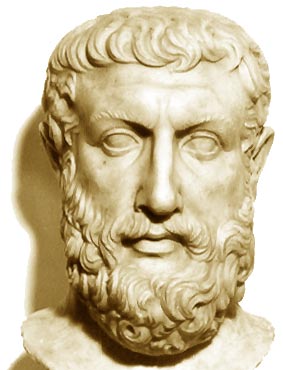
In this case, however, the “imagine …” intro is actually rather appropriate, so: Imagine something, anything.  Why?  Talking about the importance of time’s effect on verisimilitude in The Things They Carried made me think as I was hurriedly packing up to leave, ironically short on time, of a quote I remembered from somewhere, “If time is an illusion, then all objects are stationary or imagined.”  The Greek philosopher Parmenides said that, “What is various and mutable, all development, is a delusive phantom.” (Parmenides)  What he means is that if time is an illusion, nothing that exists can change or move.  This makes sense if you think of the physics – changes in displacement, velocity, acceleration, and impulse are all dependent on time.  If time is an illusion, matter can neither move nor change.  If time truly exists only in our imagination, than we ourselves do not exist, because we are never stationary completely.  Our hearts beat.  Our blood flows.  Our brains think.  Ready for a very confusing idea?  Warning – mind may be blown.  If time is imagined, than when you imagine something, you are imaginary – imagine that.  If that makes no sense to you, feel free to imagine that it does, so it will.  Although, if time is an illusion, and we are consequently nonexistent, what does it matter if you understand or not?  Why does anything matter?

Don’t worry, you matter; we all do. That whole thing about time being an illusion is just that - an illusion.  How do we know?  Well, all you have to do is think about it.  Really, it’s that simple – just think.  In fact, you needn’t ponder about the nature of time at all.  Instead, you can think about what you are going to have for dinner, whom you will have it with, and how good it will taste.  That is the undeniable proof that time exists: we can think.  If time were not real, we would be incapable of thinking, because the neural connections in our brain would not be able to transmit signals. 

Parmenides said, “to be imagined and to be able to exist are the same thing.” (Parmenides)  If he realizes that he contradicts his previously quoted claim in this way, he doesn’t seem to care – I think philosophers like confusion.  If something exists because we imagine it, and we imagine time, than time exists.  If time exists, than motion and change not only exist, but are inevitable.

            O’Brien demonstrates the influence of time and imagination upon reality in his anachronistic collection of short stories, The Things They Carried.  O’Brien does not force the reader to observe strict chronological order – if he did so, that would limit the reader’s imaginative perception, and therefore, the verisimilitude, of O’Brien’s stories.  O’Brien dismisses the importance of what he calls “happening truth”, instead relying upon “story truth”.  In his opinion, something needs not to have occurred in the past to be true.  Instead, O’Brien believes that as long as something can be imagined, it is real.  He states at one point, “That’s a true story that never happened.” (O’Brien 80) 

O’Brien agrees with Parmenides that if something can be imagined, than it exists – though with an interesting difference of philosophical distinction.  Parmenides believed that if something is imagined, then it exists in the sense of O’Brien’s “happening truth”.  To O’Brien, however, if something is imagined, the power of existence that imagination gives the imagined thing transcends the power of normal “happening truth”.  To O’Brien, truth in the imagination is the most powerful form of existence.

A final thought: according to Parmenides and O’Brien, all things imagined exist, right?  So if you imagine that that Parmenides is the inventor of Parmesan, he actually is, by his own reasoning.  I imagine I’ll go eat some noodles with parmesan.  What do you imagine?

For more on Parmenides, visit
http://www.iep.utm.edu/parmenid/

Parmenides-img
Parmenides