Saturday, September 27, 2014


Hands of God

We discussed this week a sermon called "In the Hands of an Angry God" as a preface to our reading of The Scarlet Letter.  In the sermon, the 18thcentury preacher Edwards rants on about how completely screwed the world is because sinners have angered God, and how lucky they are that they have not yet been "swallowed up in everlasting destruction." (Edwards)

            I disagree with multitudinous aspects of Edwards’s sermon, but one that connects closely with The Scarlet Letter is Edwards’s definition of sinners.  Edwards believes that any who do not concur precisely with his view of the world are doomed, and that people are supposedly angering God by not converting to Edwards’s religion, Christianity.  In The Scarlet Letter, Hester Prynne is publically humiliated and habitually ostracized because she does something that those in charge deem to be sinful, echoing in fiction the real happenings of Puritan society.  The Puritan culture from which both Edwards and Hester come is full of people very determined that they, and only they, know what is right and what God wants.  As far as the pompous Puritans are concerned, anyone who does not agree with Puritan values can – and does – go to Hell.

            The following are my own conclusions; interpret them however you please.  I don’t want to be like the Puritans we are reading about by decreeing that my views are the best and must be accepted by all.
                The point both Edwards and the people who condemn Hester seem to miss is that while people may seem to be in the wrong from a certain perspective, they aren’t necessarily wrong from God’s perspective.  I believe that God accepts each person as that person is, and does not condemn anyone to Hell.  I believe Hell is an idea created by religious authorities who wanted to keep people in line, hoping that if the promise of Heaven for doing what the authorities wanted was not enough, the threat of Hell would suffice.  The thing is, I don’t think God sends anyone to Hell.  God is forgiving, loving, and universally understanding.  If someone does do something that God does not agree with, He does not throw that person into Hell for eternity – how would that help anyone?  Instead, I believe God raises everyone up to Heaven, and enlightens each person once there as to how God wants us to be.  I believe each person is given the opportunity to make up for things that person did in that person’s mortal life, by doing what that person now knows as good, to help the world from Heaven. ☺

Saturday, September 20, 2014


Stereotypes (Punnily related to music in both textual examples - yes, maybe punnily isn't a real adverb)

I promise: this one will be shorter.  Also, I changed the background, so it should be easier to read.

This week we talked about discrimination, primarily racial, and the effects it has on society.  Sherman Alexie tells a story of a Native American man who goes into a 7-11 store at night, and is immediately racially profiled by the cashier, who expects to be robbed.  The Native American man knows what the cashier fears, and at first allows him to keep suspecting that he will be robbed.  However, the Native American man, Victor, feels sympathy for the cashier (Victor once worked at a 7-11 store himself).  He jokes around casually with the cashier, putting him at ease with a friendly, definitely-not-a-robber manner. 

Brent Staples, an African-American man, talks about the hurtful and sometimes dangerous prejudice he feels as he walks the city streets, not stalking people, but sleep.  He describes himself as he sees himself: peaceful, calm, and docile, the type of person who never wants to harm anyone.  Staples also describes himself as others see him: dangerous, prone to violence, a potential rapist or murderer.  People don’t see him as an individual, but as a member of a group that people have decided is bad news.  He uses multiple anecdotes describing how people run away from him, cross the street to avoid him, bring out a guard dog as insurance against him, and once try to arrest him as a burglar in his own work building.  Staples ends his short piece by describing his best technique to put at ease the people on the streets who fear him: he whistles cheery tunes by popular composers that seem to other people a sign that he isn’t as bad as they might fear.  Staples compares his whistling to the bells hikers wear to scare off bears, making a point about how he, the wearer of the metaphorical bells, is trying to escape harm.
 

The irony of these stories is that the true victims aren’t the people afraid to be robbed or murdered; the true victims are the innocent people suffering from negative stereotypes.  The stereotypes exist for a reason - humans have an innate talent for pattern recognition, bred into us by natural selection over millennia.  If human A recognizes a certain type of person (human B) as dangerous, because human A knows that people like human B are often dangerous, human A is more likely to survive than the non-stereotyping human C, who does not perceive a threat, and as such does not survive to pass on his or her genes.  While this may justify the creation and persistence of stereotypes, it overlooks the harm done to person D.  Person D is a human much like human B, but is different in that person D does not want to harm humans A and C.  However, person D is discriminated against for his or her likeness to human B, and as such may be ostracized, unfairly suspected, or even harmed by human A in human A’s attempt to preserve human A’s safety. 

We recognize and use stereotypes because they keep us alive and well, and because they help us to best predict the actions of others around us.  We are each human A.  However, we all should keep in mind that a human seeming to be like human B might actually be person D, who is innocent, and could be harmed as much by our stereotyping as we might be by the actions of human B.


Sunday, September 14, 2014


Imagine that (insert appropriate continuation of opener).  That’s one of the few ways we were told last year in 10 Honors was an acceptable intro for an essay.  Imagine that ..., meant to place a reader of the essay (a reader that could not be mentioned or addressed, because that would be bad form) in a mindset that would prepare the reader for the remainder of the essay.  Or, to be honest, it was for many of us simply a way to get the points for a good grabber/hook idea that hadn’t been declared cliché or too “eighth grade” by our teachers.

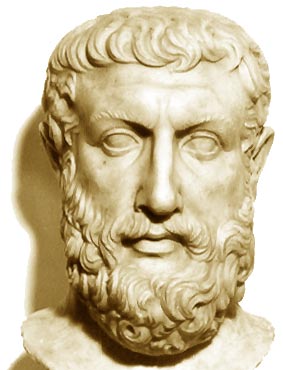
In this case, however, the “imagine …” intro is actually rather appropriate, so: Imagine something, anything.  Why?  Talking about the importance of time’s effect on verisimilitude in The Things They Carried made me think as I was hurriedly packing up to leave, ironically short on time, of a quote I remembered from somewhere, “If time is an illusion, then all objects are stationary or imagined.”  The Greek philosopher Parmenides said that, “What is various and mutable, all development, is a delusive phantom.” (Parmenides)  What he means is that if time is an illusion, nothing that exists can change or move.  This makes sense if you think of the physics – changes in displacement, velocity, acceleration, and impulse are all dependent on time.  If time is an illusion, matter can neither move nor change.  If time truly exists only in our imagination, than we ourselves do not exist, because we are never stationary completely.  Our hearts beat.  Our blood flows.  Our brains think.  Ready for a very confusing idea?  Warning – mind may be blown.  If time is imagined, than when you imagine something, you are imaginary – imagine that.  If that makes no sense to you, feel free to imagine that it does, so it will.  Although, if time is an illusion, and we are consequently nonexistent, what does it matter if you understand or not?  Why does anything matter?

Don’t worry, you matter; we all do. That whole thing about time being an illusion is just that - an illusion.  How do we know?  Well, all you have to do is think about it.  Really, it’s that simple – just think.  In fact, you needn’t ponder about the nature of time at all.  Instead, you can think about what you are going to have for dinner, whom you will have it with, and how good it will taste.  That is the undeniable proof that time exists: we can think.  If time were not real, we would be incapable of thinking, because the neural connections in our brain would not be able to transmit signals. 

Parmenides said, “to be imagined and to be able to exist are the same thing.” (Parmenides)  If he realizes that he contradicts his previously quoted claim in this way, he doesn’t seem to care – I think philosophers like confusion.  If something exists because we imagine it, and we imagine time, than time exists.  If time exists, than motion and change not only exist, but are inevitable.

            O’Brien demonstrates the influence of time and imagination upon reality in his anachronistic collection of short stories, The Things They Carried.  O’Brien does not force the reader to observe strict chronological order – if he did so, that would limit the reader’s imaginative perception, and therefore, the verisimilitude, of O’Brien’s stories.  O’Brien dismisses the importance of what he calls “happening truth”, instead relying upon “story truth”.  In his opinion, something needs not to have occurred in the past to be true.  Instead, O’Brien believes that as long as something can be imagined, it is real.  He states at one point, “That’s a true story that never happened.” (O’Brien 80) 

O’Brien agrees with Parmenides that if something can be imagined, than it exists – though with an interesting difference of philosophical distinction.  Parmenides believed that if something is imagined, then it exists in the sense of O’Brien’s “happening truth”.  To O’Brien, however, if something is imagined, the power of existence that imagination gives the imagined thing transcends the power of normal “happening truth”.  To O’Brien, truth in the imagination is the most powerful form of existence.

A final thought: according to Parmenides and O’Brien, all things imagined exist, right?  So if you imagine that that Parmenides is the inventor of Parmesan, he actually is, by his own reasoning.  I imagine I’ll go eat some noodles with parmesan.  What do you imagine?

For more on Parmenides, visit
http://www.iep.utm.edu/parmenid/

Parmenides-img
Parmenides