Imagine
that (insert appropriate continuation of opener). That’s one of the few ways we were told last
year in 10 Honors was an acceptable intro for an essay. Imagine
that ..., meant to place a reader of the essay (a reader that could not be mentioned
or addressed, because that would be bad form) in a mindset that would prepare
the reader for the remainder of the essay.
Or, to be honest, it was for many of us simply a way to get the points
for a good grabber/hook idea that hadn’t been declared cliché or too “eighth
grade” by our teachers.
In this case, however,
the “imagine …” intro is actually rather appropriate, so: Imagine something,
anything. Why? Talking about the importance of time’s effect
on verisimilitude in The Things They Carried
made me think as I was hurriedly packing up to leave, ironically short on time,
of a quote I remembered from somewhere, “If time is an illusion, then all
objects are stationary or imagined.” The
Greek philosopher Parmenides said that, “What is
various and mutable, all development, is a delusive phantom.”
(Parmenides) What he means is that if
time is an illusion, nothing that exists can change or move. This makes sense if you think of the physics –
changes in displacement, velocity, acceleration, and impulse are all dependent
on time. If time is an illusion, matter
can neither move nor change. If time
truly exists only in our imagination, than we ourselves do not exist, because
we are never stationary completely. Our hearts
beat. Our blood flows. Our brains think. Ready for a very confusing idea? Warning – mind may be blown. If time is imagined, than when you imagine
something, you are imaginary – imagine that.
If that makes no sense to you, feel free to imagine that it does, so it
will. Although, if time is an illusion,
and we are consequently nonexistent, what does it matter if you understand or
not? Why does anything matter?
Don’t worry, you matter;
we all do. That whole thing about time being an illusion is just that - an
illusion. How do we know? Well, all you have to do is think about it. Really, it’s that simple – just think. In fact, you needn’t ponder about the nature
of time at all. Instead, you can think
about what you are going to have for dinner, whom you will have it with, and
how good it will taste. That is the
undeniable proof that time exists: we can think. If time were not real, we would be incapable
of thinking, because the neural connections in our brain would not be able to
transmit signals.
Parmenides said, “to be imagined and to be able to exist are the same thing.”
(Parmenides) If he realizes that he contradicts
his previously quoted claim in this way, he doesn’t seem to care – I think philosophers
like confusion. If something exists because
we imagine it, and we imagine time, than time exists. If time exists, than motion and change not
only exist, but are inevitable.
O’Brien
demonstrates the influence of time and imagination upon reality in his
anachronistic collection of short stories, The
Things They Carried. O’Brien does
not force the reader to observe strict chronological order – if he did so, that
would limit the reader’s imaginative perception, and therefore, the
verisimilitude, of O’Brien’s stories. O’Brien
dismisses the importance of what he calls “happening truth”, instead relying
upon “story truth”. In his opinion,
something needs not to have occurred in the past to be true. Instead, O’Brien believes that as long as
something can be imagined, it is real. He
states at one point, “That’s a true story that never happened.” (O’Brien 80)
O’Brien agrees with Parmenides that if something can
be imagined, than it exists – though with an interesting difference of
philosophical distinction. Parmenides
believed that if something is imagined, then it exists in the sense of O’Brien’s
“happening truth”. To O’Brien, however,
if something is imagined, the power of existence that imagination gives the imagined
thing transcends the power of normal “happening truth”. To O’Brien, truth in the imagination is the
most powerful form of existence.
For more on Parmenides, visit
http://www.iep.utm.edu/parmenid/
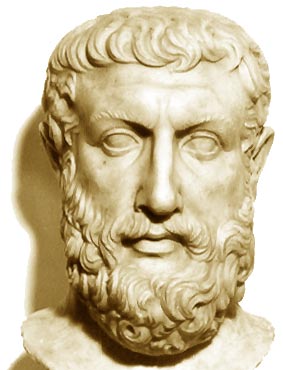 |
| Parmenides |

Jeez Michael I thought MY blog post was long...great analysis though, (although mind boggling). Your brain is obviously more advanced and more functional than mine. Anyways, someone told me once that there's no limit to the human imagination, so does that mean there's no limit to what can exist? So if I can imagine unicorns, then they can be real? That was an allusion to your shirt.
ReplyDeleteI also imagine that you will read my post because our final sentences are kind of matching.
Michael!! Awesome job on your blog, it was very insightful and in depth! Awesome visuals (including your background :) ). One suggestion i might add is maybe to change you font and its style so that it may be easier to read? Other than that it is beautiful.
ReplyDeleteIt was a very interesting idea of taking the idea of imagined memories to a whole new level. The idea that time is imagined really hurts to think about; I'll be excited to see what you write next week!
ReplyDelete